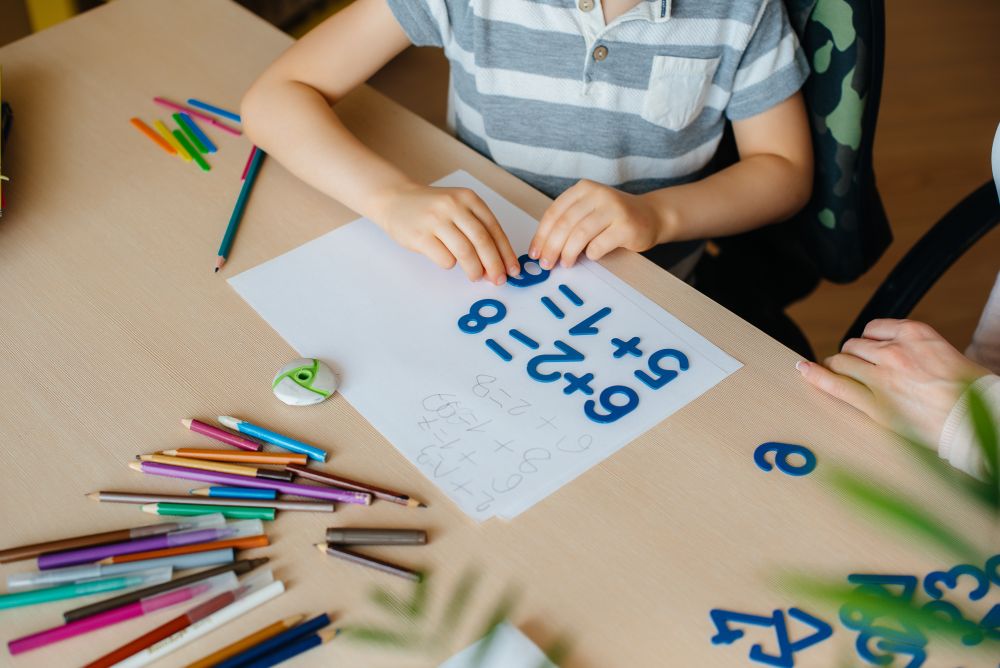

The first year of secondary maths generates a particular kind of worry in households that had no reason to worry before. A child who was comfortable through primary school comes home with a test paper in the sixties and cannot explain what went wrong. Before deciding anything, it helps to know which parts of that are normal, which parts are worth acting on, and how quickly. Math sec 1 is a genuine transition year, not simply the next rung up.
Why the First Year Feels Harder Than Expected
Three things change at once. The content becomes abstract, with letters standing in for numbers. The pace roughly doubles, since secondary schools cover a topic in a fortnight where primary schools took a term. And the teaching moves from heavily guided to substantially independent, on the assumption that students will consolidate at home. A student can cope with any one of those changes. Meeting all three in the same January is what produces the dip.
What Full Subject-Based Banding Changed
With subject-based banding now running across secondary schools, students take individual subjects at different levels rather than sitting in a single stream. In practice this means a child’s maths level is reviewed on evidence rather than fixed at posting, and movement between levels is a normal administrative event rather than a demotion. It is worth explaining this to a child directly. Students who understand the system as adjustable treat a difficult term as information; students who think it is permanent tend to give up on themselves.
Reading the First Report Card Properly
A single mark tells you almost nothing in term one. What matters is which questions were lost and how. Sit down with the actual paper. Marks lost on the last two questions of a paper suggest time pressure or unfamiliar problem types. Marks scattered evenly across easy and hard questions usually means shaky fundamentals. Marks lost on working, with correct answers, is a presentation habit and the quickest of all to fix.
Careless Is Usually Not Careless
Parents and students both reach for careless as an explanation, and it is nearly always the wrong one. Repeated sign errors mean negatives were never properly understood. Repeated slips in fraction arithmetic mean fractions are not fluent enough to run in the background while the student thinks about the actual problem. Genuine carelessness is random and rare. A pattern of the same mistake is a gap wearing a disguise, and it will not respond to being told to check more carefully. Where that gap sits in primary material, going back to it directly through something like p6 maths tuition is quicker than drilling Sec 1 questions that quietly depend on it.
How to Help Without Teaching
Most parents last taught this material decades ago, under a different syllabus, using methods the school no longer uses. Teaching a shortcut that contradicts the school’s approach reliably makes things worse. What does help: asking the child to explain a worked example aloud, which exposes gaps faster than any test; protecting a consistent, unglamorous study slot; and keeping the emotional temperature down, because a student who feels judged stops admitting what they do not understand.
Practice, and Where It Stops Helping
Volume works only while the method is sound. A student repeating a misconception across forty questions is rehearsing the misconception. Ten questions, marked properly, with the errors understood and reworked, beat sixty questions marked with a tick and a cross. The useful sequence is short, corrected, and revisited a week later. Anything else tends to produce a thick stack of completed worksheets and no measurable change.
When to Bring in Outside Support
There is no need to react to one bad test. Look instead for a pattern across a term: consistent difficulty despite real effort, a student who has started to describe themselves as bad at maths, or gaps clearly rooted in primary content that the secondary teacher has no time to revisit. Any of those is a reasonable trigger. One disappointing paper in February is not, and reacting to it tends to teach a child that a single bad result is a crisis.
Choosing a Programme That Actually Fits
Ask how the centre diagnoses a new student, and be sceptical of anywhere that places by level alone without looking at written work. Ask the class size, since maths teaching depends on someone seeing how a student reasons on paper. Ask whether the material follows the school’s sequence or runs on its own track, because a mismatched schedule adds load rather than removing it. And ask what happens when a student is still lost after the lesson.
Keeping Four Years in View
Sec 1 sets up Sec 2, which sets up the O-Level or equivalent syllabus, and the compounding runs in both directions. Gaps left unaddressed get more expensive every term. Equally, a student who genuinely consolidates algebra in the first year usually finds Sec 2 easier than Sec 1, which is a common and underreported pattern. A weak start is recoverable. A weak start left alone for two years generally is not.
What to Do This Term
Go through the last maths paper with your child rather than the grade. Identify whether the losses are fundamentals, method, or time. Fix fractions and negative numbers before anything else if they are shaky. Establish a short daily habit rather than weekend marathons. Get support if the pattern persists past the second assessment, and for students who need extension rather than remediation, look at enrichment such as GEP tuition instead. Most Sec 1 problems are ordinary and fixable, provided somebody looks at the working.