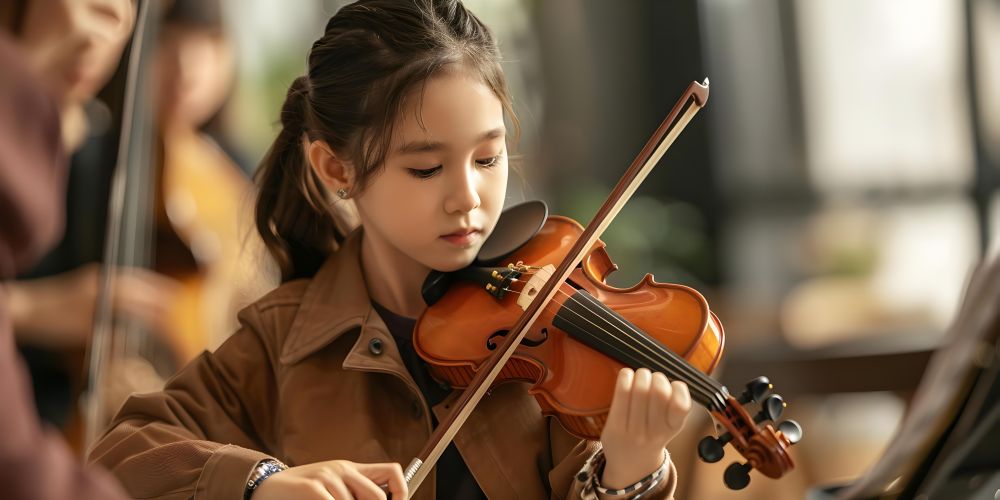

The scientific literature on violin classes for kids reveals a paradox that has puzzled music educators and neuroscientists for decades. Children who begin violin instruction before age seven develop neural pathways distinct from those who start later, yet success rates among very young beginners remain stubbornly inconsistent. A 2019 longitudinal study tracking five hundred young violinists across three years found that whilst early starters showed advantages in pitch discrimination and fine motor control, dropout rates peaked highest among the four-to-six age group. The data suggests that timing matters, but perhaps not in the straightforward ways parents often assume when enrolling their children in music programmes.
The Suzuki Method: Origins and Implementation
No discussion of violin classes for kids can proceed without examining the Suzuki method, developed by Japanese violinist Shinichi Suzuki in the mid-twentieth century. Suzuki’s core insight, revolutionary at the time, proposed that children could learn music through the same natural processes they acquire language. His method eliminated traditional notation in favour of listening, imitation, and repetition during initial learning phases.
The Suzuki approach in practice involves several distinctive elements:
- Parent attendance at every lesson, with one parent learning alongside the child
- Heavy emphasis on listening to recordings of pieces before attempting to play them
- Group lessons supplementing individual instruction
- Delayed introduction of music reading, sometimes not until after two years of playing
- Standardised repertoire progression starting with simple folk melodies
Singapore’s violin instructors implementing Suzuki methods report that “parental involvement correlates strongly with student persistence, but creates challenges when parents lack time or struggle with their own learning difficulties.” This observation points to a tension inherent in the method. The requirement for sustained parental participation makes it poorly suited to dual-income families with limited discretionary time, a significant consideration in Singapore’s work-intensive culture.
Traditional Classical Methods: Structure and Rigour
Alternative approaches to violin education for young students follow more conventional paths emphasising music literacy from the outset. These methods introduce notation reading during the first several lessons, building sight-reading skills parallel to technical development. Students learn scales, arpeggios, and etudes alongside repertoire, creating a comprehensive foundation in music theory.
The traditional methodology offers particular advantages:
- Earlier independence in learning new pieces without instructor demonstration
- Stronger theoretical understanding supporting later advanced study
- Compatibility with school music programmes using standard notation
- Less demanding parental involvement requirements
However, the initial learning curve proves steeper. Children may require six to twelve months before playing complete, recognisable pieces. For young students whose motivation depends on early tangible achievements, this delayed gratification can test commitment.
The Physical Realities: Size, Posture, and Development
The biomechanics of kids’ violin training present challenges absent in many other instruments. Violins come in fractional sizes, with one-sixteenth and one-eighth sizes accommodating children as young as three. Yet size matching proves more complex than simple height or age calculations. Arm length, hand size, and finger span all factor into appropriate instrument selection.
Proper violin posture requires sustained muscle engagement that young children find difficult to maintain. The left arm must hold its position against gravity whilst fingers press strings with precise pressure. The right arm executes controlled bow strokes maintaining consistent speed and pressure. Meanwhile, the neck rotates to position the chin on the chinrest. This coordination challenge explains why many programmes recommend starting no earlier than age five or six, when neuromuscular development reaches necessary thresholds.
A 2021 study from the National University of Singapore’s music department tracked posture development in seventy young violin students. Researchers found that children under six required average correction every four minutes during lessons compared to every twelve minutes for seven-year-olds. The data illuminated why younger starters often progress more slowly despite neurological advantages.
Practice Expectations: The Evidence on Duration and Frequency
Perhaps no aspect of violin instruction programmes for children generates more debate than practice requirements. Traditional wisdom holds that daily practice proves essential, but research paints a more nuanced picture. A meta-analysis examining practice habits across two thousand young string players found that practice quality outweighed duration significantly. Twenty minutes of focused, mindful practice with specific goals produced better outcomes than hour-long unfocused sessions.
Singapore music educators emphasise that “establishing consistent practice routines matters more than hitting arbitrary time targets, particularly during the first year when habit formation occurs.” This perspective aligns with behavioural psychology research showing that regularity creates automaticity, reducing the willpower required for sustained engagement.
Effective practice sessions for young children incorporate:
- Warm-up exercises focusing on posture and bow hold
- Slow, deliberate repetition of challenging passages
- Frequent breaks preventing physical and mental fatigue
- Recording and playback for self-assessment
- Clear, achievable goals for each session
Parental Role: Support Without Pressure
The involvement of parents in youth violin programmes operates along a continuum from essential participation in Suzuki methods to minimal engagement in traditional approaches. Yet regardless of method, research consistently identifies parental attitude as a critical variable affecting persistence and enjoyment.
Parents who view practice as collaborative problem-solving rather than compliance monitoring foster better outcomes. When children encounter frustration with difficult passages, parents who respond with curiosity rather than disappointment help develop resilience. Conversely, excessive pressure or criticism correlates with higher dropout rates and negative associations with music.
The challenge lies in balancing support with autonomy. Children need structure and accountability but also ownership over their musical journey. Finding this equilibrium requires ongoing adjustment as children mature and their needs evolve.
For families considering the substantial commitment that violin classes for kids require, understanding the methodological options, physical demands, practice realities, and parental dynamics helps ensure decisions rest on evidence rather than assumptions about what musical education entails.