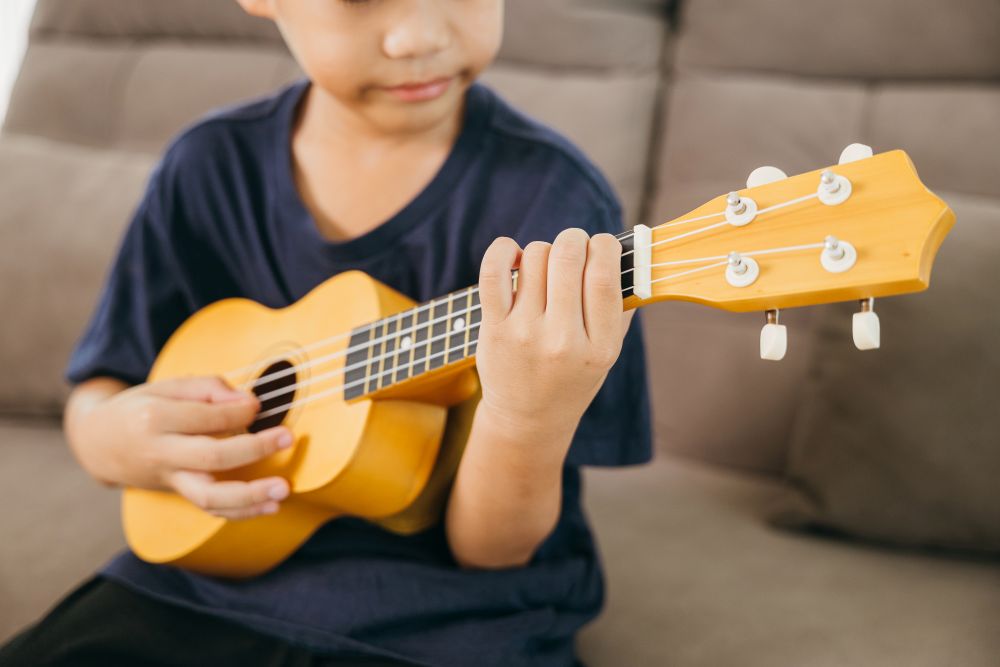

The market for ukulele lessons for kids Singapore provides has expanded considerably since 2018, driven by a convergence of factors that music educators and instrument retailers began noticing around that time. Sales data from Singapore’s major music stores showed ukulele purchases increasing by thirty-eight percent between 2017 and 2020, with the sharpest growth in child-sized instruments. Teachers reported waiting lists for beginner ukulele classes where previously they struggled to fill seats. What accounted for this shift, and what happens inside these classes that has made the ukulele an increasingly preferred starting instrument for young children?
The Structural Advantages: Why Ukuleles Work for Young Learners
The appeal of ukulele lessons for kids Singapore rests on practical considerations that become apparent when examining the instrument itself. A soprano ukulele weighs roughly four hundred grams compared to a child-sized guitar’s two kilograms. This weight difference matters significantly when a six-year-old must hold an instrument for twenty or thirty minutes. The ukulele’s compact neck span suits smaller hands, requiring less finger strength and stretch than guitar chords demand.
The four-string configuration simplifies initial learning. Children can learn basic chords within two or three lessons, playing recognisable songs almost immediately. This rapid achievement creates momentum that sustains interest through more challenging concepts introduced later.
Nylon strings prove gentler on tender fingertips than steel guitar strings. Instructors report that children learning ukulele experience less finger pain and consequently maintain practice habits more consistently during crucial early months. One veteran music educator observed that “the physical comfort factor cannot be overstated when working with young students whose pain tolerance and frustration thresholds are naturally lower than adults.”
Curriculum Structure: How Programmes Build from Foundation to Fluency
The architecture of ukulele programmes for young learners in Singapore follows recognisable patterns across different teaching institutions. Most programmes divide into progressive stages spanning eighteen to twenty-four months before students achieve intermediate proficiency.
The foundational stage, typically lasting eight to twelve weeks, introduces:
- Proper holding position and strumming technique
- Basic chord shapes, usually C, F, G7, and Am
- Simple strumming patterns using downstrokes
- Reading chord diagrams and basic tablature
- Playing along with familiar children’s songs
This initial phase prioritises building confidence and establishing practice routines.
The intermediate stage, extending from months three through nine, expands technical knowledge:
- More complex chord progressions and barre chords
- Varied strumming patterns including upstrokes and muting
- Basic fingerpicking techniques
- Introduction to music notation and rhythm reading
- Ensemble playing with other students
By this stage, students typically handle pieces requiring chord transitions and rhythm variations. The curriculum incorporates both traditional songs and contemporary music appealing to children’s current interests.
The advanced beginner stage, roughly months ten through eighteen, introduces:
- Full range of common ukulele chords including seventh and minor variations
- Fingerstyle arrangements of popular melodies
- Basic music theory including scales and key signatures
- Solo performance techniques
- Song composition and improvisation fundamentals
Singapore’s music education specialists note that “students reaching this level with solid fundamentals often transition successfully to guitar or other string instruments if they choose, having developed core musicianship that transfers across instruments.”
Skill Development Beyond Musical Technique
The value proposition of Singapore’s children’s ukulele training extends beyond chord mastery and rhythm competence. Longitudinal observations document broader cognitive and social benefits emerging from sustained musical instruction.
Motor skill development proceeds along multiple dimensions. Fine motor control improves as children learn precise finger placement. Gross motor coordination advances through maintaining proper posture and executing controlled strumming motions. Hand independence develops as students coordinate left-hand fretting with right-hand strumming.
Cognitive benefits accumulate through regular practice. Pattern recognition strengthens as students identify recurring chord progressions. Memory capacity expands through learning repertoire. Mathematical reasoning develops through understanding rhythm and timing.
Social and emotional development often proves the most transformative aspect:
- Performance anxiety management through regular recitals
- Delayed gratification tolerance as complex skills require sustained effort
- Self-efficacy building through mastering progressively difficult material
- Collaborative skills through ensemble playing
- Cultural appreciation through exposure to diverse musical traditions
Assessment Methods and Progress Tracking
Quality ukulele education for kids in Singapore incorporates systematic progress evaluation. Some programmes use standardised examination systems adapted from guitar certification frameworks, requiring students to demonstrate technical proficiency and repertoire performance at defined intervals.
Other programmes favour portfolio-based assessment where students record performances throughout the year, documenting improvement through video or audio evidence.
Parent communication typically includes:
- Termly progress reports detailing technical skills and practice habits
- Regular informal updates through messaging platforms
- Semester-end recitals where parents observe student development
- Home practice guides explaining current learning objectives
The Practice Equation: What Home Support Requires
The effectiveness of any ukulele instruction programme for children depends significantly on practice consistency between lessons. Instructors generally recommend fifteen to twenty minutes of daily practice for young beginners, gradually increasing to thirty minutes as students advance.
Successful practice habits typically involve parental support during early stages. Parents need not possess musical knowledge but should provide structure: establishing consistent practice times, creating distraction-free environments, and offering encouragement without pressure.
For families investigating musical education options, understanding curriculum structures, realistic timelines, and necessary home support helps ensure that pursuing ukulele lessons for kids Singapore offers becomes a decision grounded in practical expectations rather than wishful assumptions about effortless musical development.